First Impressions of the Gozney Arc Lite
The box is light enough to lift onto a counter alone. Inside, the oven comes whole, with its gas hose and regulator already attached. There is nothing to build. A stone tool, a Torx key and a short start guide make up the rest.
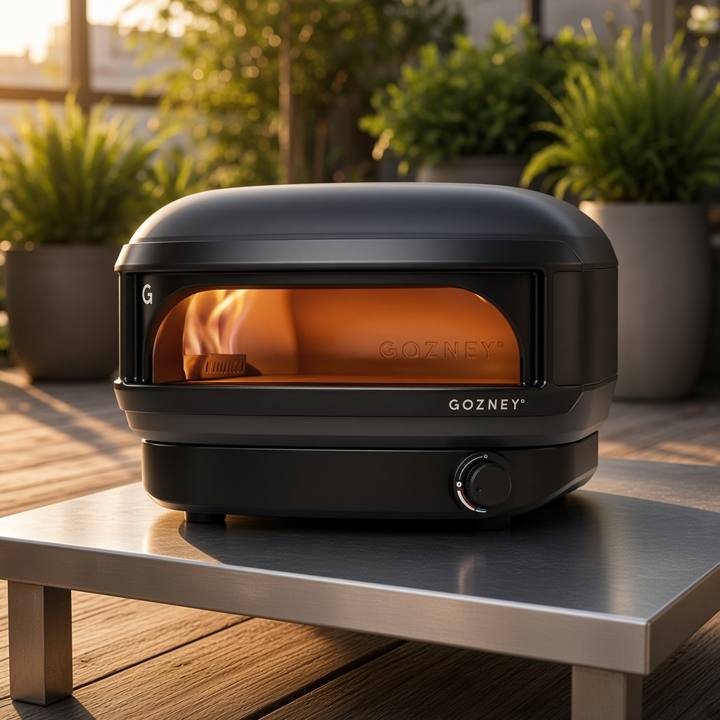
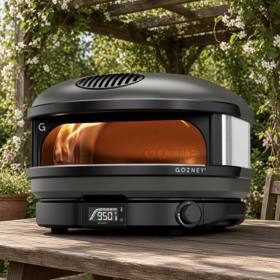
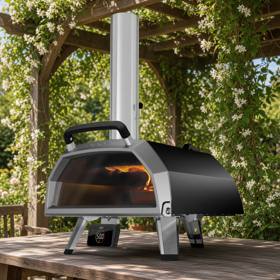
At 16.9 inches wide, the Lite looks like an Arc that shrank in the wash. It keeps the same rounded hood and matte black body. Up front there is a single dial on the base and nothing else. That blank face is the first sign of a cut.
With a cylinder connected, one turn of the dial lit it. A flame rose along the left wall and curled over the roof toward the right side.
The first pie went in once the floor read hot on a handheld infrared gun. Out it slid with a puffed cornicione, dark freckles across the rim and a firm underside.
The left edge had charred ahead of the right. Later pies got a quarter turn halfway. The bake was unmistakably Gozney.
Key Features of the Gozney Arc Lite
Read this list as a ledger. Every line is a part the Lite kept from the Arc, or a place Gozney saved.
- Lateral rolling flame: One burner sits along the left side. Its flame climbs the wall and rolls across the dome. That top heat cooks toppings while the floor handles the base.
- 12 mm cordierite floor: The stone is half an inch thick and lifts out. That is 8 mm thinner than the Arc’s slab. Less mass means it heats faster and cools faster.
- Fully insulated body: Gozney insulates the whole shell. The outside stays far cooler than the flame inside, which matters on a crowded patio.
- Front control dial: Lighting and flame height both live on one knob. Turned low, it suits a skillet of prawns or a tray of peppers.
- No onboard thermometer: The Arc carries a digital gauge. The Lite carries none. You read the stone with your own infrared gun or by eye.
- A 12.8 inch mouth, 3.35 inches tall: The slot is wide enough for a 12 inch pie with little to spare. It is lower than the Arc’s opening.
- Cover: Gozney sells an Arc Lite Cover separately. It also offers a stand and a booster that fit both the Arc and Arc XL.
Gozney rules out indoor cooking with this oven. An open propane flame under a low hood explains why.
The headline matches the bigger oven. Gozney rates the Lite to 950 F, the same top heat as the Arc. The flame is not where the saving shows. The dome got hot fast and the crusts blistered properly.
The saving shows in the floor. A 12 mm stone charges quickly. The first pie was ready sooner than on a thick slab.
Then each bake pulled heat back out of it. A second pie launched straight after the first had a paler base.
The fix is simple. Leave a few minutes between pies with the dial high. After that, the third pie matches the first.
On a quiet night for two, nobody notices the wait. With a queue of hungry guests, everyone does. The Lite rewards a slow rhythm.
The smaller floor changes the dough as well. A 12 inch pie wants a smaller ball, stretched thin. Keep toppings light and dry. A wet, heavy pie soaks the base before this stone can crisp it.
Turning remains part of the job. Heat rolls off the left wall, and the crust nearest it colors first. Rotate once or twice per pie, using a small turning peel through the low slot.
Gas output is something Gozney chooses not to print, in the US or the UK. That leaves the Lite to be judged by its crust, which holds up well.
Build, handling and durability
The shell feels solid for its weight. Panels meet cleanly and the hood sits square. The insulation does its job. Around the base, the outer skin stays touchable during a bake.
Handling is the clearest gain over the Arc. At 26.4 lb, one person can carry it from storage to table and back. Nothing folds out, and nothing zips it up for travel.
So it is portable only in the sense that it fits in a car trunk. At home it needs a steady, heat-safe surface.
Durability hinges on the stone. Thinner cordierite has less mass to soak up a sudden shock. A cold, wet dough or a careless knock are the usual culprits. Treat it gently and it should last.
Gozney’s warranty runs one year as standard and stretches to five with registration inside 60 days. The paperwork is the only effort that warranty asks.
Running costs, upkeep and value
The Lite drinks from an ordinary propane cylinder, hooked to its own hose. Gozney gives no figure for gas use. A cost per pie is therefore anyone’s guess.
The small chamber and insulated body point to a modest appetite. Most bakes ran below full flame once the floor was charged.
Cleaning takes little effort. Spilled flour and stray cheese carbonize on a hot floor and brush off once cool. Keep soap away from the stone, because cordierite soaks it up. Dark stains are cosmetic.
The removable floor helps. A cracked slab is a part swap, using the supplied tool, rather than a lost oven. The Torx key in the box suggests the shell can be opened for service too. Brushing out the back corners of such a small chamber is fiddly, though.
Value is the Lite’s strongest suit. Around $399.99 buys the same rolling flame, the same 950 F rating and an insulated body. The Arc costs $799.99 for a larger floor, a thicker stone and a gauge.
Set aside some of the $400 difference for an infrared thermometer, since you will need one. The cover is extra too, as is a stand if no table suits.
Ordered from Gozney itself, delivery costs nothing anywhere in the contiguous US. Its returns run 30 days for unused ovens in the original box. For a buyer unsure about pizza ovens at all, that safety net has real worth.
Possible Gozney Arc Lite Complaints
- The stone runs out of heat on a busy night. Twelve millimeters of cordierite holds little in reserve, so back-to-back pies come out pale underneath. A short pause on full flame between bakes fixes it. The price is a slower evening.
- There is no way to read the oven without extra kit. The Arc’s gauge is gone and nothing replaces it. Owners end up buying an infrared gun anyway. Factor that into the budget from the start.