Traeger Woodridge Elite vs Weber Searwood XL 600
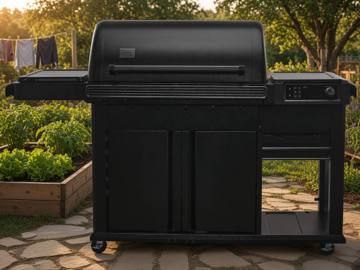
$1,799.99 for 970 sq in, 500 F and an electric side burner, against $1,199 for 972 sq in and 600. Pan heat on a 67-inch cart, or more heat at the grate.
We pick the Weber Searwood XL 600 Pellet Grill
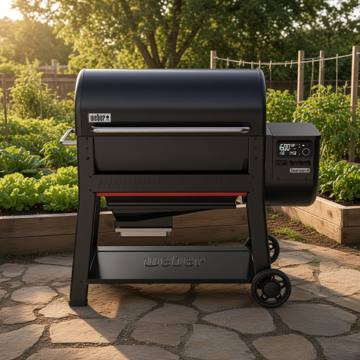
The Searwood, unless you specifically want a pan on the cart. The Elite costs about $600 more, and its fire stops at 500 F. Its extra is a glass electric hob set at LO, MED or HI, with no published output. The Searwood puts the heat on the grate instead, up to 600. Weber's Manual mode runs fuel and fan steadily for griddling, and a Crafted griddle insert is $99.99 on a $49.99 frame kit.
What actually differs
-
Three settings and a rule book
The Elite's hob has nothing between LO, MED and HI. It stops heating when the pan lifts for ten seconds, and bars metal utensils from the glass. It handles sauces and sides, not a second grill's work.
-
A griddle on the grate against a hob beside it
Weber's route to pan cooking is a frame kit and an insert, $149.98 together. That is far less than the Elite's premium, but the griddle takes grate space the Traeger's hob leaves free for the smoke.
-
67 inches and 221 pounds
The Elite is the widest and heaviest Woodridge, on casters alone, and wants 20 inches clear of anything combustible. The Searwood spans 50.50 inches and weighs 157.80 pounds. Measure the patio first.
-
Both makers put the costly parts on three years
Traeger files the side burner in its three-year row; the ten years cover rust-through only. Weber gives the Searwood's grates, burn pot and deflector three years too. Neither long term covers what you are paying for.
The scorecard, side by side
Both reviews are scored on the same six weighted categories, each bar on the same 0–10 scale, and every cell carries the reason that review gave. A row is marked won only where the two differ by a tenth or more. How we score →
The Pro Plus's grate, ceiling and Super Smoke window exactly; the side burner publishes no output, so it adds nothing here.
A 180 to 600 span with no large sheet diffuser is unusual reach for an auger-fed cooker.
The ten-year headline covers rust-through on sheet metal; the side burner you paid for sits in the three-year row.
Weber covers the cook box for five years, and everything that burns or fails for three.
Cabinet and 221 lbs of steel feel solid, but a glass cooking panel lives outdoors on caster-only wheels.
157.80 pounds, a porcelain-enameled lid and stainless Flavorizer bars, but the grate metal is printed two ways.
Traeger's controller and app are as simple as ever, though the burner adds a small rule book of its own.
A fuel gauge that alerts you at low pellets, two probes, Wi-Fi and Bluetooth, all included.
Four hundred dollars over the Pro Plus adds an electric hob with three settings and no extra grate space.
$1,199 buys probes and connectivity, but the cover is $94.99 and the front table another $99.99.
One keg catches grease and ash, but the firepot still wants vacuuming and the burner wants wiping and covering.
Grease and ash pull out together from the front, rather than from under a loaded cabinet.
Published figures that differ
Quoted from each maker's own specifications, as each review records them. Figures the two products publish identically are left out — only the differences are listed.
Which one is for you
You want sauces and sides on the same cart as the smoke, and have 67 inches of patio to give it.
Check price →You want searing heat at the grate, a griddle as an option, and about $600 kept back.
Check price →More head-to-heads
Every score and figure on this page comes from our own reviews of these two products, linked above. We have not tested them side by side in one place; the comparison is between two full reviews, each built from the maker's published specifications and documentation. Prices move, and the ones quoted are the ones each review checked on its own date.