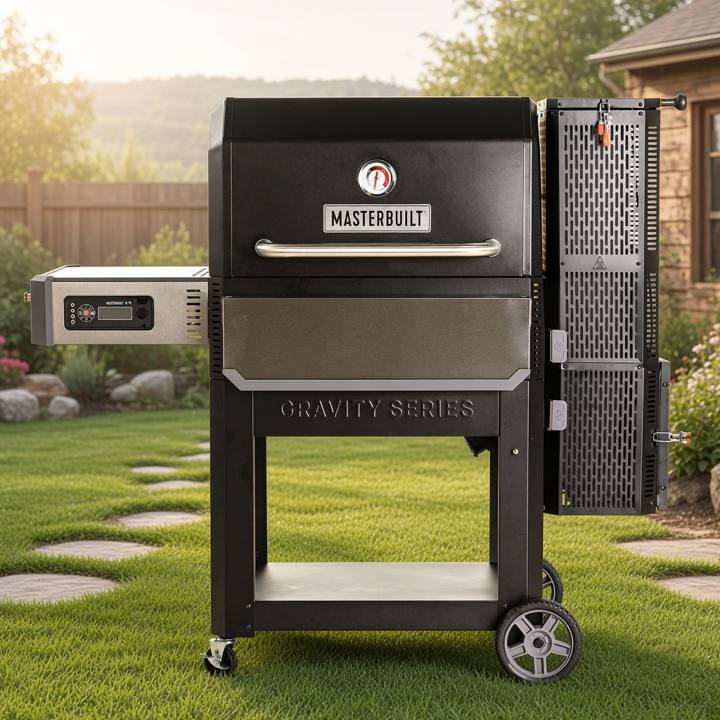
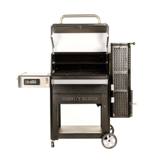
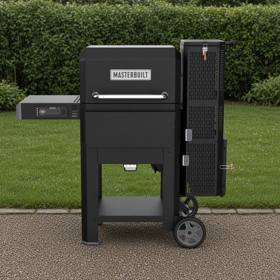
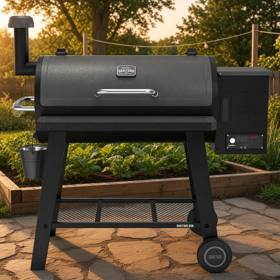
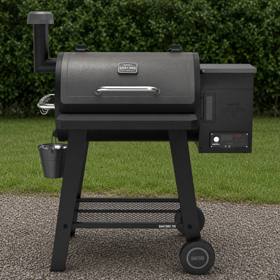
The Gravity Series 1050 is the largest of Masterbuilt’s regular Gravity grills. Charcoal goes in a tall side tower rather than under the food. A fan and a digital controller hold whatever heat you set.
Size is the whole pitch. The model MB20041220 claims 1,050 square inches, room for 17 chickens.
Yet the price ladder is odd. Masterbuilt lists the smaller 600 at $799.99. The griddle-topped 800 costs $999.99, exactly what this one costs.
So the question is narrow. Who actually needs the biggest Gravity? And what does that size cost them in charcoal, patio and money?
1,050 sq inCooking space, counting the foldaway racks
16 lbBriquettes the hopper takes, or 10 lb of lump
8 to 10 hoursBurn per load, as Masterbuilt prints it in different places
60.6 inWidth across controller, cookbox and hopper
First Impressions of the Masterbuilt Gravity Series 1050
Wheeled out, the 1050 reads as three boxes in a row. The controller pokes out on the left. Between them, the lidded chamber rides an open frame with a low shelf. On the right rises the vented fuel tower, its top level with the lid’s shoulder.
That row is 60.6 inches wide, a shade over five feet. Masterbuilt’s own artwork prints 61. Add room to open the lid and reach the hopper, and a small deck feels full.
Inside the lid, the cookbox has two levels. Down low sits the heavy iron, where the searing happens. Above it, foldaway racks swing up to hold food out of the direct heat.
Your opening session cooks nothing. Masterbuilt asks for a seasoning run with the hopper a quarter to half full. It runs 60 minutes at 250°F, then 30 minutes at 400°F. Let it cool, oil the grates and lid, and run the cycle again at 350°F.
That burn-in is worth noticing. Even the maker’s own procedure never fills this hopper.
Key Features of the Masterbuilt Gravity Series 1050
The 1050 shares its working parts with the smaller Gravity grills. What changes is the volume of everything. Here is what you get, read with that extra room in mind.
- GravityFed hopper. Fuel loads from the top and drops toward the fire by its own weight. Fill it with briquettes and it swallows 16 pounds; lump tops out near 10.
- DigitalFan. Mounted low, it feeds oxygen past the burning charcoal toward the food. The controller ramps it up or idles it down.
- Digital control panel. The left-hand box carries a display and buttons. Punch in a figure, and the fan chases it.
- App and Wi-Fi. On a phone, you change the heat, watch a timer and follow up to four probes. Whether any arrive with the grill, or how many, is left unsaid.
- Reversible cast iron grates. Flip each panel to choose between a ridged sear face and a smoking face.
- Foldaway warming racks. Hinged upper shelves in a porcelain finish park finished food out of the fire. They are also a big share of the 1,050 figure.
- Front and side shelves. Prep space lives on the cart itself, so you need less table beside it.
- Removable ash bucket and grease tray. Both slide out for emptying.
- Add-ons sold separately. Extras for this line include a Pizza Oven, a Flat-Top Griddle and a $99.99 Rotisserie Kit.
Lighting is simple. A single wax starter tucked into the fuel does it; after that, airflow is automatic.
On paper, 8 minutes reaches 225°F, and 15 reaches 700°F. Charcoal rarely moves that quickly. So a Tuesday steak skips the chimney starter entirely.
The 700°F top end lands on cast iron, which holds heat and marks meat well. At the other end, the spec block says 225°F. Yet a marketing panel elsewhere on that page puts the smoking floor at 250°F. Plan your low and slow cooks around 250°F until your own grill shows you otherwise.
Smoke is easy to add. For quick smoke, the maker puts wood in the ash bin, not the hopper. One or two chunks no bigger than a fist last two to three hours. For longer runs, you layer chunks between charcoal in the hopper.
The size question shows up here. The 1,050 number is a stack, not a floor. Masterbuilt never says how much of it is main grate and how much is rack.
Picture the 17 chickens on the box. Some of them may sit upstairs, away from the direct heat. That suits slow cooks, where rack space is useful. It suits a burger rush far less, since every patty wants the cast iron.
A big chamber also has more air to heat. Here the fan earns its keep. You set a number and it pushes air until the chamber gets there, then backs off.
Build, handling and durability
The cart is a proper base, with shelves front and side. Big wheels carry the hopper side. Little casters roll the controller side. With no published weight, we leave that number blank.
What Masterbuilt does name is the cooking hardware. Cast iron carries the meat; the upper racks wear a porcelain finish. The body and hopper metal go unnamed, and so does any gauge.
One handling rule matters more than any material. The hopper has metal slides used to close it off.
During a cook those slides belong fully out, hung on a hook by the side shelf. Left in, they can damage the slide and the grill.
That is an easy rule to forget on a busy day. On a cooker this size, a forgotten slide is an expensive mistake. Hang them in the same place every time, and the habit forms quickly.
Running costs, upkeep and value
Fuel is what you keep buying, and the oversized tower sounds thirsty. You do not have to fill it. It only sets the ceiling on how long one load can last.
That ceiling is printed three ways. Masterbuilt’s page says up to 10 hours. A comparison chart says 10+ hours in one load. Two of its own gallery images say up to 8 hours instead.
None of them says at what heat. A low smoke burns far less than a 700°F sear. So read the long figure as an overnight smoke, never an evening of searing. For a weeknight, load what the cook needs and no more.
Masterbuilt sells a Lump Charcoal Bundle 2 Pack with fire starters for $64.99. How much fuel a typical cook burns goes unpublished. So we cannot price a cook for you.
Routine cleaning means tipping out a bucket of ash and a tray of drippings. Of everything on this cooker, the iron grates are the fussy part. Masterbuilt says frequent seasoning helps prevent rust. Rusted grates get a steel brush and a coat of shortening.
Value hinges on the family lineup. At $999.99 list, or around $989 on Amazon in September 2026, it matches the 800. That model trades grate room for a griddle.
Step up and the 1150 costs $1,199.99. Step down and the 600 saves real money. The 1050 is the value pick only if raw capacity is what you are short of. For most households, it is not.
Possible Masterbuilt Gravity Series 1050 Complaints
- A one-year warranty on a lot of moving parts. The fan, the controller and the app link all ride on that single year. After it, any repair is your bill.
- A headline number that overstates the grate. The 1,050 figure counts the foldaway racks. If you need flat searing room for a crowd, the true grate share is unpublished. Look at the cookbox in person before you size a party around it.