Weber Traveler Compact vs Weber Traveler
240 sq in at 37 lb and $299, against 320 sq in at 49 lb and $399. Same materials, one burner each. Which Traveler actually fits your car.
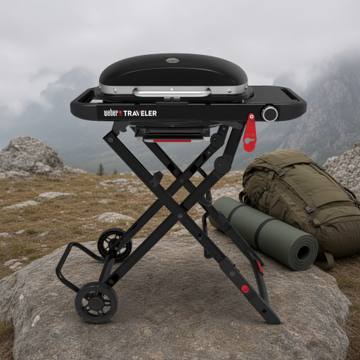
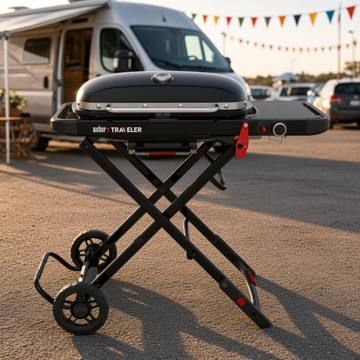
We pick the Weber Traveler Compact Portable Gas Grill
The Compact is the better buy for most people, and the denser fire. It puts 11,000 BTU under 240 sq in — 46 BTU per square inch — in a 34-inch, 37-pound package for $299. The full-size Traveler spreads 13,000 BTU over 320 sq in, which works out to 41 BTU per square inch, at 49 pounds and $399. Materials are identical: glazed cast iron, a porcelain lid, a welded frame, nothing downgraded.
What actually differs
-
The smaller grill has the hotter surface
46 against 41 BTU per square inch. Weber did not shrink the burner as far as it shrank the grate, so the Compact is the one more likely to brown properly.
-
One burner either way, so neither has a cool zone
This is the honest limit of both. A single tube under the whole grate means no part of it can be kept cooler, so anything needing indirect heat is out of scope for both grills.
-
12 pounds and 12 burgers
37 pounds against 49 decides whether this goes in a small car boot without a second thought. Weber counts 12 burgers on the Compact, which is the figure to check your own use against.
The scorecard, side by side
Both reviews are scored on the same six weighted categories, each bar on the same 0–10 scale, and every cell carries the reason that review gave. A row is marked won only where the two differ by a tenth or more. How we score →
11,000 BTU under 240 square inches is a denser fire than the larger Traveler, but one burner leaves no cooler zone.
One 13,000 BTU tube sits under 320 square inches of iron, so no part of the grate can be kept cooler.
The five-year headline reaches the cookbox and lid only; the lever and hinges doing every trip's work sit in the two-year bracket.
Weber advertises five years, then gives the burner tube and grates three, and the folding hardware that works hardest only two.
Glazed cast iron, a porcelain lid and a welded frame, identical to the $399.00 Traveler with nothing downgraded for the price.
Porcelain-enameled lid and cast iron grates on a one-piece frame, with wheels Weber rates for grass and dirt.
One lever, one knob, a self-locking lid, and 37 pounds against the larger Traveler's 49, with no assembly published.
Nothing to assemble, one lever to stand it at cooking height, and no table needed underneath it anywhere.
$299.00 against $399.00 buys the same materials and a smaller grate, though the $99.99 griddle stays a third of the purchase.
$399.00, down from $449.00, buys the frame and the grate; the cylinder, the cover and the $99.99 griddle are extra.
A grease tray that pulls from the front, glazed surfaces that wipe, and a split grate that lifts in two halves.
Grease pulls out from the front and enamel wipes clean, though the drip pans are a $10.99 refill.
Heat density
Burner output over the surface it has to heat, derived in each review from that cooker's own published figures. A bigger number is not a better grill — it says how hard the cooker can drive its grate, nothing more. All grills ranked →
Published figures that differ
Quoted from each maker's own specifications, as each review records them. Figures the two products publish identically are left out — only the differences are listed.
Which one is for you
You want the lightest, hottest, cheapest Traveler and cook for four to six.
Check price →You regularly feed more than six and the extra 80 sq in matters more than 12 pounds.
Check price →Every score and figure on this page comes from our own reviews of these two products, linked above. We have not tested them side by side in one place; the comparison is between two full reviews, each built from the maker's published specifications and documentation. Prices move, and the ones quoted are the ones each review checked on its own date.