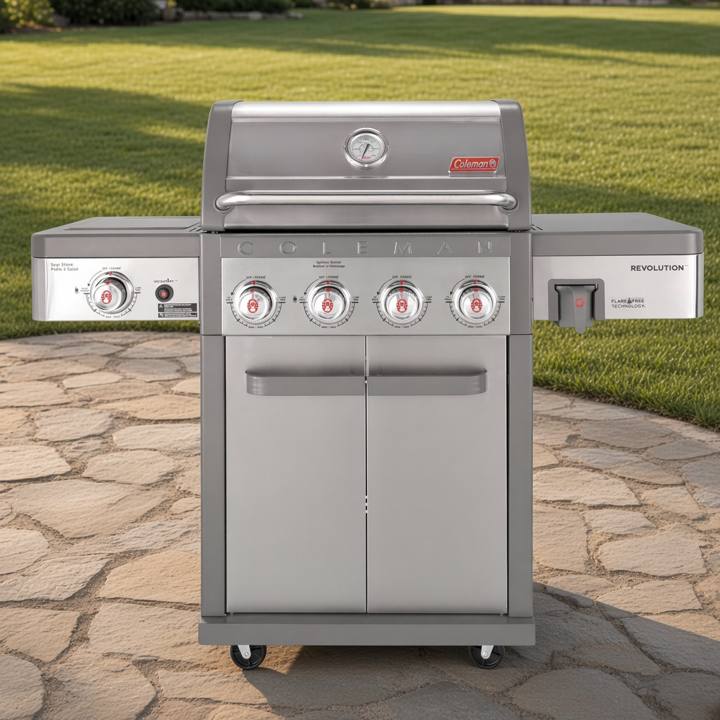
Most gas grills let drippings fall on the burners and burn off as smoke. The Coleman Revolution 4-burner, model RV-401BBQ, is built so they never get there. Porcelain-coated iron rides on top of a pressed steel layer. The fat runs forward to a cup.
That design is the whole pitch. It is also the whole question. When fat stops reaching the fire, where does it go, and who moves it? Follow that question and it leads to flavor, chores and paperwork.
Coleman licenses its name here. Winners Products Engineering builds and warrants the grill under a Coleman licence. Keep that name in mind when the warranty comes up.
First Impressions of the Coleman Revolution 4-Burner
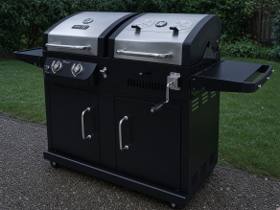
The Revolution reads as a conventional cabinet grill from across the yard. A brushed stainless lid with a dome thermometer sits over four knobs with red Coleman badges. Two cabinet doors hide the propane tank. A lidded side stove fills the left shelf, and a plain prep shelf fills the right.
The difference is under the lid.
Lift a top grate and a second steel grate waits beneath it. Its rods are shaped into channels that run toward the front. A stainless trough collects what they carry. A cup at the front right of the cookbox takes it.
Assembly is a two-person job, and the maker says so plainly. You will need two Phillips screwdrivers, two slotted ones, an adjustable wrench and pliers. The grates must be stacked before they go in. Leveling is in the instructions, since the drain works best on a level cookbox.
At 128.9 pounds, this grill lives where you assemble it. The Amazon copy calls it portable and mentions beaches. Four casters, two of them locking, move it around a patio, not to a park.
Placement matters too, because this is a propane grill for open air only. The manual wants at least 36 inches from anything combustible. Never run it in a garage or on a covered porch, or under any overhang. Keep it clear of windows, siding and fences.
Key Features of the Coleman Revolution 4-Burner
Everything on this grill orbits one idea: keep grease away from the burners. The rest is a familiar four-burner kit, priced low.
- Flare-Free Technology, double-stacked: Three porcelain cast iron top grates rest on three stamped steel lower grates. Drippings follow the lower layer forward. Coleman claims it captures and removes 75% more grease, without saying compared with what.
- Two grease cups: A front cup takes what the grates channel, and it is dishwasher safe. A side pullout cup catches what reaches the cookbox floor.
- Stainless steel: The four burners are 304 stainless. Maker photographs show stainless fronts on the lid, panel and doors. The frame is powder coated steel.
- Cast-iron: The top grate is porcelain cast iron. It needs seasoning with vegetable shortening before the first cook.
- Push-button igniter: Instastart is a battery spark lighter, fed by one AA cell. The maker rates it weatherproof.
- Side Burner: A 13,000 BTU side stove with its own lid and grate. Its output stays separate from the 50,000 BTU main total.
- Porcelain heat plates: Four plates sit over the burners. A metal scraper can chip their coating, so the manual asks for a brush.
- Convertible valves: A Convertible Valve System kit can switch the grill from propane to natural gas. It is sold separately.
- Warming rack: A 180 sq in rack above the grate, counted inside the 680 sq in headline.
Divide the 50,000 BTU of the main burners by the 500 sq in grate. You get 100 BTU for every square inch of primary grate. Our Weber Spirit EX-425C review derived 82 the same way. Raw output is no weakness here.
The fourth burner adds 5,000 BTU over the 3-burner, on the same grate.
The cast iron top grate helps that output land as sear marks. An iron rod banks heat and dumps it into whatever touches it. The maker says to preheat on high for 5 to 10 minutes. Then drop to medium for most cooking.
What the design changes is flavor, and Coleman frames that as a gain. Drippings that would sizzle on a heat plate now slide toward a cup. You lose most flare-ups, and some of the smoky char they bring.
If you like a little flame licking a fatty steak, this grill works against you. If burned chicken skin is your recurring problem, it works for you. The 13,000 BTU side stove sits apart from all this, under its own lid. It handles a skillet of onions while the main grate stays shut.
No maker heat range or recovery figure is published. The case for its heat rests on the ratio and the grate, not a measurement.
Build, handling and durability
The parts that take the heat are good ones for the money. Stainless 304 burners, porcelain heat plates and cast iron grates are a solid set here. The maker does not name the cookbox metal, and the frame is powder coated steel.
Over the years, the clever part becomes the weak link.
The stacked grates, the channel and the cups are the reason to buy this grill. Those are exactly the parts with the short warranty. Winners Products’ written terms give the burners, manifold and carryover bar 5 years. Grates, grease parts and the side stove drop to 2, with 1 for the rest.
There is a second catch.
The manual’s warranty text says it applies only to grills used in Canada. Amazon’s listing simply says “5 Year Limited”. Our research found no US warranty document. US buyers should get terms from the maker in writing first.
Running costs, upkeep and value
At around $487.49 on Amazon, sold by Amazon itself, the Revolution sits well below Weber’s four-burner. The listing shows a $699.99 list price, so that is $212.50 off. The Weber Spirit EX-425C sat at around $749.00 the same day, $261.51 more.
Oddly, the Revolution 3-burner costs more than this one. Amazon had it at around $727.70, which is $240.21 above the 4-burner. Both share the same 500 sq in grate and cart. The 3-burner simply has one fewer burner and a smaller rack.
Propane is the cost you expect; scraper time is the one you might not. Here the fat feeds a cup, not the fire. The cup is yours to empty. The manual lists emptying it under “Every Use”.
A 10 to 15 minute burn-off on high should follow each session as well. That burn-off is gas you pay for.
Deeper cleaning means lifting two grate layers, pulling the channel shield, and scraping the trough. The top grate wants fresh seasoning several times a season. None of it is hard, but a single grate over a tray takes fewer steps.
Natural gas is the other cost question. The kit is sold separately, and the manual names only a Canadian part number. No US price for it was published.
The listing carries just two Amazon ratings so far, averaging 1.5 stars. Two ratings are far too few to read anything from.
Possible Coleman Revolution 4-Burner Complaints
Both likely complaints come from the same design choice, which is why they are worth naming.
- Grease that stalls instead of draining: The channels only run if the grill is level and the trough stays clear. Debris pulled forward with the cleaning tool can clog the channel. If flare-ups suddenly return, the manual reads that as a cleaning signal. Pushing debris toward the back, as instructed, avoids most of it.
- A warranty that may not travel: The written terms cover grills used in Canada, and the defining parts get 2 years. A US buyer could find a grate claim harder than expected. Amazon lists the grill as non-returnable, so check terms first. Keep the invoice and register the grill on the maker’s site.