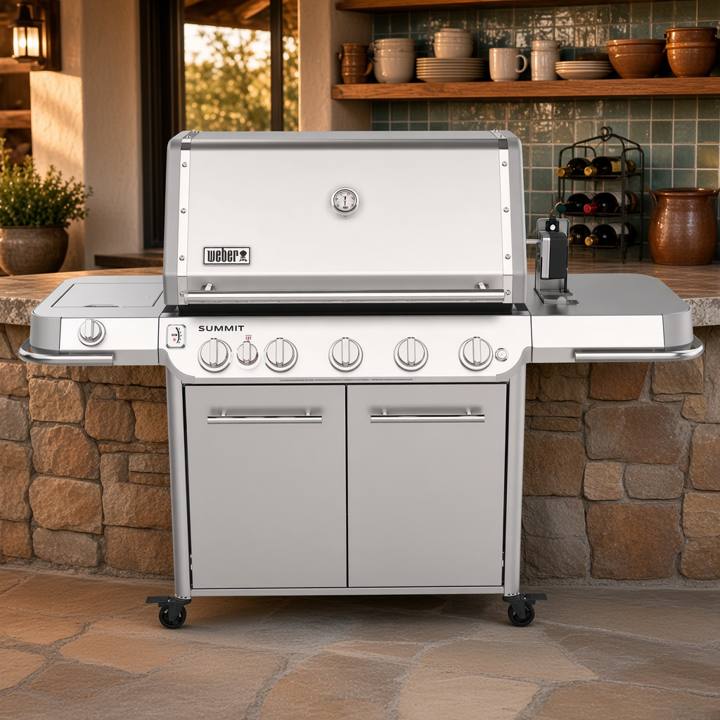
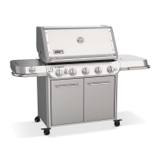
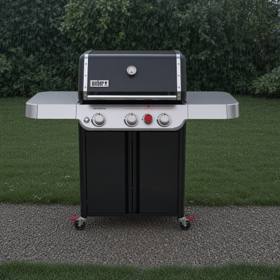
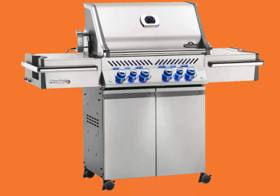
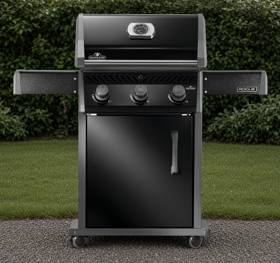
The Weber Summit FS38 S, part 1500028, carries every flame its smart sibling carries. Its main fire is 65,000 BTU, spread across five tubes. Overhead, a 16,000 BTU infrared element glows down at the meat. The rotisserie and smoker box come in the carton.
What it leaves out is the glass. The Summit Smart FS38X S adds a touchscreen, an app and food probes. In late November 2026, Amazon priced that model at $5,299. This one was $3,999.
That is $1,300, and not a dollar of it burns propane. So what does a cook actually give up by keeping the knobs?
First Impressions of the Weber Summit FS38 S
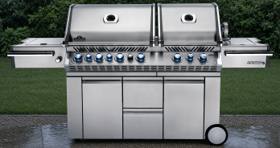
It reads as a smaller Summit only when the two stand side by side. Tables included, it measures 70.7 inches from end to end. Brushed steel wraps the hood, the knob fascia and the cabinet front. The cabinet doors swing on soft-close hinges, a detail usually reserved for kitchens.
Look at the control strip and the family resemblance ends. Six bladed metal knobs run across it, each ringed by a backlit LED. Nothing needs pairing, updating or waking up. For a reading, you get one dial on the hood.
Building it is not a solo job. Weber’s assembly guide asks for three people and rules out power tools. It also wants a flat, soft surface underneath while you work.
Two small touches stand out once it is built. The propane tank hangs on a scale, with its gauge set into the control panel. The rotisserie motor hides under a panel in the side table. It rises out only when a spit goes on.
Key Features of the Weber Summit FS38 S
Take the smart layer off and the hardware list does not change. That is the point of this model, so the list below is mostly about fire. Only the control panel differs from the FS38X S.
- Top-down infrared broiler: 16,000 BTU aimed at the top of the food from inside the lid. Weber sizes it for two New York strips or four filets.
- Adjustable upper grate: The stainless top grate sets at three heights below the broiler. Thick roasts drop lower; thin steaks ride close to the glow.
- Rotisserie, included: A heavy-duty spit turns beneath the broiler. The motor plugs into a GFI-protected outlet, so plan a cord route.
- Side burner: A 12,000 BTU ring under its own lid. Sauce and beans stay off the grates.
- Electronic igniter: Each burner lights from its own knob, one at a time, left to right. If one fails, Weber first checks gas flow with a long lighter, then the battery.
- LED controls: Six backlit metal knobs. They are the panel’s only electrical flourish.
- Fuel gauge: A standard 20 lb cylinder hangs on a scale in the cabinet. A gauge beside the knobs reads its level.
- Stainless steel: The lid, the five PureBlu burners and the FLAVORIZER bars. Weber’s spec table adds the 9mm solid rod grates.
- Smoker box, included: Wood chips go in a big stainless box. Park it on any part of the grate, or lift it out.
- Weber Crafted ready: With the frame kit, the main grate takes a griddle, a pizza oven or a wok.
- Slide-out grease tray: An angled tray and catch pan collect what the bars do not vaporize.
Below the grates, the two Summits are twins. Both carts spread the same 65,000 BTU over the same 681 square inch grate. You get 95.4 BTU per square inch, matching the smart model exactly. Nothing about removing a screen changes a flame.
The broiler justifies a Summit, and Weber’s own manual is candid about its limits. Run it on high with the lid open, after holding the knob 20 to 30 seconds. Expect weaker broiling if the main burners are also running. That makes it a finishing station for a pair of steaks, not a second grill.
On its low setting, the broiler becomes the rotisserie’s heat source. A bird turning under it browns on every face as it rotates. Weber suggests setting a fresh foil pan on the bars, right under the spit.
So what does the cook lose here? Measurement, mostly. The smart model tells you the meat’s internal reading; this one tells you the lid’s. A good instant-read probe closes most of that gap.
The screen’s other trick is guidance. On the FS38X S, SmartControl shows where food should go and sets the heat. Here those calls are yours, made by hand on the knobs. Anyone who has run a multi-burner grill already makes them without thinking.
Build, handling and durability
Weber builds both carts from the same stainless parts list. Weber’s spec table lists the grates as 9mm solid stainless rods. A header on that same page says cast iron instead. Burner tubes and FLAVORIZER bars are stainless as well.
The differences are in the chassis. This cart is about four inches narrower than the FS38X S. Weber lists it at 247 pounds against 275.
It also rolls on four casters, two of them locking, where the smart sibling gets six. On a flat patio that matters little. On a slope, fewer locks means more care when parking it.
One limit appears as a warning in the manual. This cart may not be built into any surround. For masonry, look at the Summit SB38 S built-in, which slides into an island opening. Those wanting more counter around the same cookbox can look at the GC38 S grill center.
Running costs, upkeep and value
Money first. At $3,999, you get every burner, spit and smoker box of the $5,299 model. The $1,300 difference buys a touchscreen, SmartControl guidance, the Weber Connect app and probes.
A wired Weber probe with three sensors costs $29.99 on its own. That hints at how little hardware the gap holds.
Extras cost extra here, just as on the smart model. The griddle insert that drops into the cookbox was marked down to $219.99 from $269.99. A premium cover is $119.99. The Weber Crafted griddle is $99.99, before the frame kit it needs.
Then there are the batteries, which surprise people buying a knob grill. Weber specifies 2 AA, 3 C and 6 D cells. The six D cells sit in a pack at the bottom right of the cabinet. Weber advises pulling them if the grill will sit idle for a month.
If the cookbox or hood rusts out within 15 years, Weber answers for it. Inside the cookbox, tubes, rods and FLAVORIZER bars are warranted for a decade. Electronics get 3, and every remaining part gets 5. With no touchscreen aboard, less of this grill sits in that shortest tier.
Routine upkeep is light. Brush the rods, scrape the bars, and check the grease tray before every cook. Never brush the broiler’s ceramic face, though. Weber suggests a full clean at least twice a year.
Possible Weber Summit FS38 S Complaints
- A screenless grill still needs power twice over. It takes eleven cells, and the spit motor needs a GFI-protected outlet. You feel it the first time a spit goes on and no outlet is near. Run an outdoor circuit before the grill arrives, and keep spare D cells.
- The broiler asks for patience. You hold the knob for up to 30 seconds while the ceramic lights. High heat also needs the lid open, and broiling weakens with the main burners on. Light it last, once the grates have done their work.