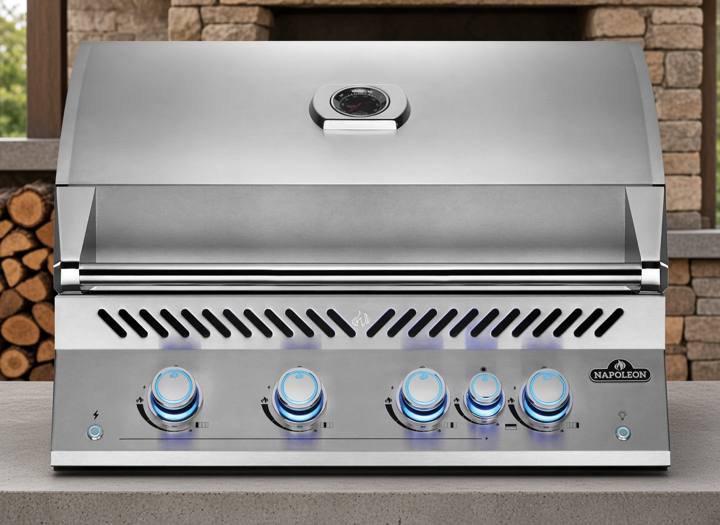
Napoleon sells two 32-inch grill heads that drop into the same counter opening. The cheaper one, the Built-In 500 Series 32, lists at $1,679. This one, the Built-in 700 Series 32 (BIG32RBNSS-1), lists at $2,219.
Both run four main burners and both are rated for 32 burgers. So the $540 gap has to buy something else. It buys an infrared rear burner, a rotisserie kit, hood lights and heavier grids.
The question is whether those extras earn their keep for the way you actually cook. In this grill review, the answer turns on one line in the owner’s manual.
First Impressions of the Napoleon 700 Series 32
This is a grill head, not a grill. It arrives with no cart, doors or legs. It is made to sit inside an island you build. The shipping figure is 178 pounds, so plan two strong people for the lift.
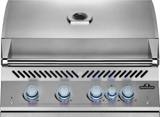
From the front it reads as one long stainless face. A deep vent strip runs above five knobs, and the lid carries a round ACCU-PROBE gauge. One knob in the right-hand group is smaller than the rest. That one runs the rear burner.
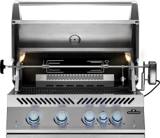
Raise the lid and the price gap becomes visible. Four stainless tube burners run front to back under sear plates and wave-shaped grids. An infrared panel sits high on the back wall, facing forward rather than up.
A warming rack spans the rear of the box. It must come out before the rear burner is lit, or the heat will damage it. That one detail tells you how hot the back wall runs.
The first cook is simple. Each knob pushes and turns to fire its own jet of flame. There is no battery to fail. Give it about 10 minutes on high, hood down, and the grids are ready to sear.
Key Features of the Napoleon 700 Series 32
What separates this head from its cheaper sibling sits mostly at the back of the firebox. The rest is wiring. The cooking surface itself is familiar Napoleon hardware.
- Infrared rear rotisserie burner: a glowing panel on the back wall that roasts a turning spit with radiant heat. Take it away and you have the cheaper head.
- Rotisserie kit included: a two-fork commercial grade kit, with an integrated storage tray under the grill.
- Stainless steel throughout the head: hood, firebox, tube burners, sear plates and cooking grids are all stainless.
- WAVE cooking grids: thick stainless rods bent into a wave, so small food has less room to drop through.
- Push-button igniter, battery free: the JETFIRE system shoots a jet of flame at each burner. Cross-lighting brackets relight a neighbour that blows out.
- Illuminated cooking surface: halogen lamps inside the hood, plus knobs that glow blue at rest and red when lit.
- Rotisserie: the motor mounts on the side bracket and the spit sits on hangers across the box.
- Installation aids: integrated trim, an extra long flex line and longer wiring. The cut-out also gets a 2-inch tolerance.
Napoleon prints one heat figure for this grill: 66,000 BTU. That number adds the four main burners to the infrared rear burner. The manual then says plainly not to use the rear burner while the main burner runs. So the full 66,000 never fires at once.
Think of it as two grills that take turns. One is a four-burner sear grill. The other is a rotisserie oven heated from the back wall. You pick which one tonight’s dinner needs.
Seared chops and a spit-roast chicken cannot share the fire. One finishes, then the other starts. On a busy evening that sequencing is the real cost of the design.
The rear burner earns its place on long, slow roasts. A whole chicken or a pork loin turns in front of it. The mains stay dark. Set a metal dish under the meat to catch drippings, as the manual advises.
That bundled figure also blocks a fair heat density reading. Napoleon never splits the 66,000 between mains and rear burner. Dividing the whole sum by the 531 sq in grate would overstate it. So we leave that figure out.
What the grate side does well is hold heat. The wave grids measure 9 to 9.5 mm thick, depending on the Napoleon page. Mass like that keeps a hard sear going when a cold steak lands. Four separate burners also allow zones, one side hot and one side off.
Build, handling and durability
The build answers the price better than the feature list does. Every part that touches flame is stainless, and the warranty leans on exactly those parts. Burners, grids, hood and aluminum castings carry lifetime cover. The sear plates, the infrared rear burner and everything else carry 15 years.
That split matters for the rotisserie question. The rear burner is the part you pay extra for. It gets 15 years rather than life. Commercial or communal use cuts all of it to two years.
One build caveat is documentation rather than metal. Napoleon’s product page lists the grids at 9.5 mm in one paragraph. Another paragraph says 9 mm, and its own 0.354 inch conversion agrees with that. Either way the grids are heavy, but a maker should state its own spec once.
The head also wants room around it. Behind the head, keep anything that burns 24 inches away. Each side needs 7 inches. Siting it tight against a timber wall is not an option.
Napoleon draws matching OASIS cabinets for this exact head. That takes some guesswork out of the island plan.
Running costs, upkeep and value
The $540 gap is a value question first. Price each extra by how often you would light it. The 500 Series 32 fits the same opening and keeps four burners and the 32-burger rating. The 700 adds the rear burner, the spit kit, the hood lamps and heavier grids.
The 500’s grids are 7.5 mm thick. That is the one difference you would taste.
If you spit-roast a chicken most weekends, that premium buys a real cooking method. If the rotisserie would live in its tray, you are mostly paying for lights.
Installation costs sit outside the sticker too. Without Napoleon’s Zero Clearance Liner, the cabinet frame must be non-combustible. That liner lists at $729.
The lights need a GFI-protected outlet feeding a 12VAC transformer, so budget for an electrician. Natural gas also needs a supply line sized for 7 inches water column at the grill. Neither job is unusual, but neither is free.
Upkeep is the cheap part. Dual-level sear plates shield the burners and steer drippings to perforated grease plates. Empty the grease tray before each cook and brush the grids after preheating. The manual rules out lining the drip pan with foil.
Expect the stainless grids to discolour for good. The manual says so, and it is cosmetic. The matching cover, part 61830, lists at $89.99 and is worth buying on day one.
Possible Napoleon 700 Series 32 Complaints
- The headline output is not usable output. The 66,000 BTU on the box counts a burner you cannot run alongside the mains. Buyers comparing grills by BTU alone will overrate this one. Compare four-burner grate performance instead.
- The Amazon listing is non-returnable. It ships from a third-party seller, Spotix, under hazardous materials rules. A cut-out mismatch becomes your problem, not the seller’s. Confirm the 30 to 32 inch opening and the 10.25 inch cut-out height before ordering.