The 24 inch Big Joe comes as a Series I, II or III. The Series I, model BJ24RH, is the oldest design and the cheapest. It is not old stock.
On 20 October 2026 the maker’s page still offered it new. The price was $1,499.99, with an Add to cart button.
That same morning, the Big Joe II page read sold out. So at Kamado Joe the live choice was this grill or the Series III. The gap between them is $1,800.
Both cook on the same 450 square inch circle, over the same 225°F to 750°F range. That leaves this grill review one simple question. What does $1,800 buy that never touches the food?
First Impressions of the Kamado Joe Big Joe Series I
The crate is a commitment before it is a grill. Kamado Joe puts the grill weight at 358.9 lbs. Two people and a plan are the minimum for the move off the pallet.
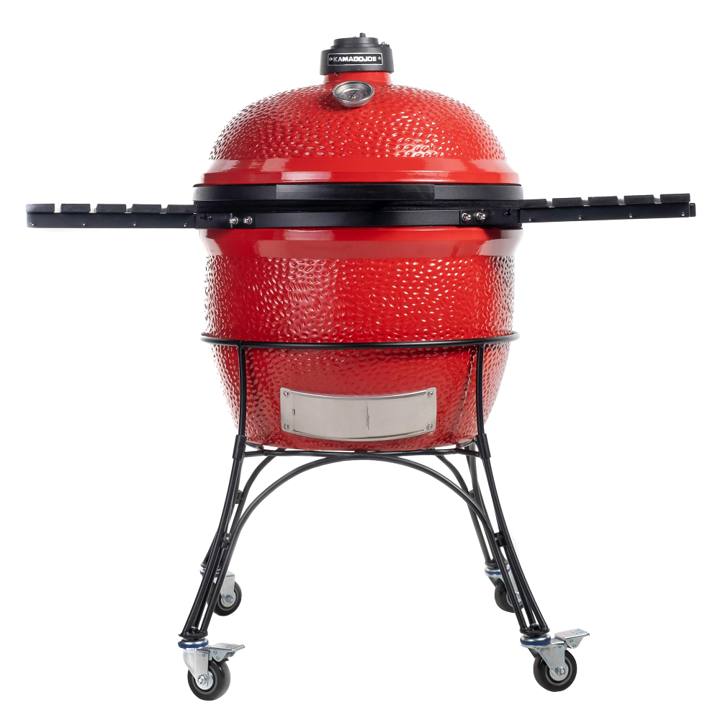
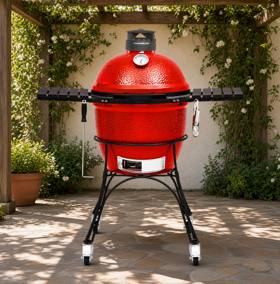
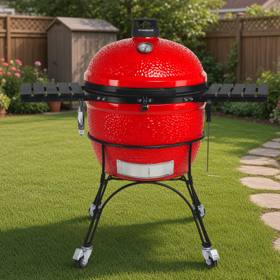
Built, it reads as a big red egg on a black wheeled frame. The cart legs arch outward, and four locking casters sit at the corners. Slatted shelves swing out to 58.3 inches wide. Up top, a squat cast iron cap sits over the dome’s round dial.
That cap is the first clue to the series. The dearer Big Joes wear a taller tower vent. Then you reach for the handle, and the second clue arrives. The dome comes up on your arm alone, and it is a lot of ceramic.
Once it is lit, the mass starts paying you back. Thick ceramic walls bank the heat and release it gently. Ribs over the deflector come off glossy and smoke-dark, with no fuss in between.
Key Features of the Kamado Joe Big Joe Series I
Kamado Joe publishes a three-column chart of its series, and the Series I column is short. Here is what ships on the BJ24RH. Nearly every line also appears under Series II.
- 24 inch ceramic body: One 24 inch circle gives 450 square inches of grate. Size is identical across all three series.
- 2-Tier Divide and Conquer: Half-moon grates sit at two levels. You can sear on one side and hold food higher on the other.
- Cast-iron top vent: A cap that turns to meter exhaust. It works well, but it is not the Kontrol Tower.
- Multiple vents or dampers: The cap pairs with a lower draft opening. Those two settings are the whole thermostat.
- Slide-out ash drawer: It sits under the band at the front. Pull it, tip it, slide it home, with the grates still loaded.
- AMP firebox: The maker’s artwork shows a ceramic firebox in sections. The artwork credits that split with holding heat and avoiding cracks.
- Stainless steel: The cooking grates are stainless steel. Nothing on the cooking surface needs oiling against rust.
- Cast iron cart with locking wheels: The series chart lists the same cart for Series I and II. The Series III gets a heavy-duty steel one.
- Folding HDPE side shelves: Black slats in HDPE hinge up for a tray and fold flat after.
- Built-in thermometer and ash tool: Both ship with the grill.
Three things on the chart are missing from this column. They are the Kontrol Tower vent, the fiberglass mesh gasket and the Air Lift hinge. The Series III adds the SloRoller insert, a charcoal basket and a third grate tier.
Nothing in the $1,800 gap reaches the fire. Kamado Joe prints 225°F to 750°F for every Big Joe. The grate is the same 24 inches too. A brisket here cooks in the same ceramic as one in a Series III.
Low and slow is where this body is happiest. A thick shell, once settled, holds a smoking temperature with little help. The maker’s artwork says five pork butts fit, which suits a long overnight cook.
The difference shows in how you hold a setting. That iron cap turns smoothly, yet nothing on it shows where you left it. Lift the dome to spritz and the cap can shift. A Kontrol Tower is built to keep its setting through that lift.
Throw both vents wide and the lump climbs fast. The stainless grate takes a good crust on a thick steak. Split the two tiers and a sear zone sits beside a gentle one.
Two tiers against the Series III’s three is the only cooking difference on the chart. A third level is extra room for a crowded cook, not extra heat. On a 24 inch circle, two levels already hold a tray of sides above the meat.
Build, handling and durability
The heavy parts match the Series II exactly. Ceramic shell, iron cart and steel grates carry over unchanged. The sectioned AMP firebox comes too, and that matters on a body this large.
Where this grill comes up short is the band between dome and base. The chart dots fiberglass mesh for the two dearer columns. This column is blank. What fills that blank on a Series I goes unstated.
Plan on buying a new gasket one day. Its cover lasts two years.
The missing hinge matters to durability as well as comfort. A 24 inch dome that slips from a tired hand lands hard on its rim. Lowering it gently, every time, protects the ceramic more than any warranty does.
Oddly, this grill is the lightest of the three on paper. The Series II’s sheet reads 407.4 lbs and the Series III’s 406.3 lbs. That puts 48.5 lbs more on the Series II. Kamado Joe never says where it sits.
Running costs, upkeep and value
Start with the three list prices. The Series I is $1,499.99, the Series II $2,299.99 and the Series III $3,299.99. Our September 2026 capture of the Amazon listing showed the same $1,499.99.
Another $800 buys the Series II hinge, tower vent and better gasket. All three sit in the lid. The $1,800 step to the Series III adds a basket, the SloRoller and a steel cart.
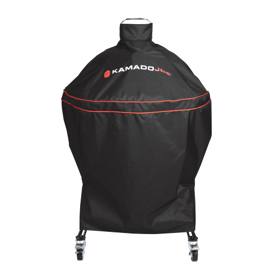
Extras arrive the same way on any Big Joe. The maker sells a Series I and cover bundle at $1,586.99. Add $229.99 if you want the Big Joe basket, or $399.99 for the JoeTisserie spit. The house lump, Big Block, is $34.99 a bag; other brands burn fine.
The Series II shows sold out at the maker, which leaves a plain fork. Pay $1,499.99 and lift the dome yourself, or pay $3,299.99 for every assist. Some retailers may still hold Series II stock, so it is worth asking.
Upkeep is the strong suit. The drawer slides out and empties in moments, so ash never builds up. A sealed ceramic can be smothered after a cook. The unburned lump then lights again next time.
Warranty terms match the rest of the range. Cracked ceramic is the maker’s problem for as long as you, the first buyer, keep it. Two years protect the dial and gasket, three the deflectors, five the metal. Skip the online registration and the cover never starts.
Possible Kamado Joe Big Joe Series I Complaints
- The dome is a full lift, every time: Nothing assists the 24 inch lid. Stand to one side and lift with your legs, not your back. Shorter cooks feel it most, and on long sessions it adds up.
- Vent settings drift and do not repeat: The cast iron cap has no stops, and a dome lift can nudge it. Set it early, adjust in small turns, and give each change time.